Tool Intelligence Teaches TRON 2 How to Work on Construction Sites
Physical AI company ZINOVA has successfully demonstrated a scaled-down tilt-up construction workflow using LimX Dynamics’ TRON 2 dual-arm robot. Developed with RIC Robotics, the demonstration covered formwork assembly, multi-layer rebar placement, and rebar tying.
The POC validates how embodied robots can use existing tools in complex construction workflows. It demonstrates how industry innovators can build vertical applications powered by an innovative embodied robotic platform.
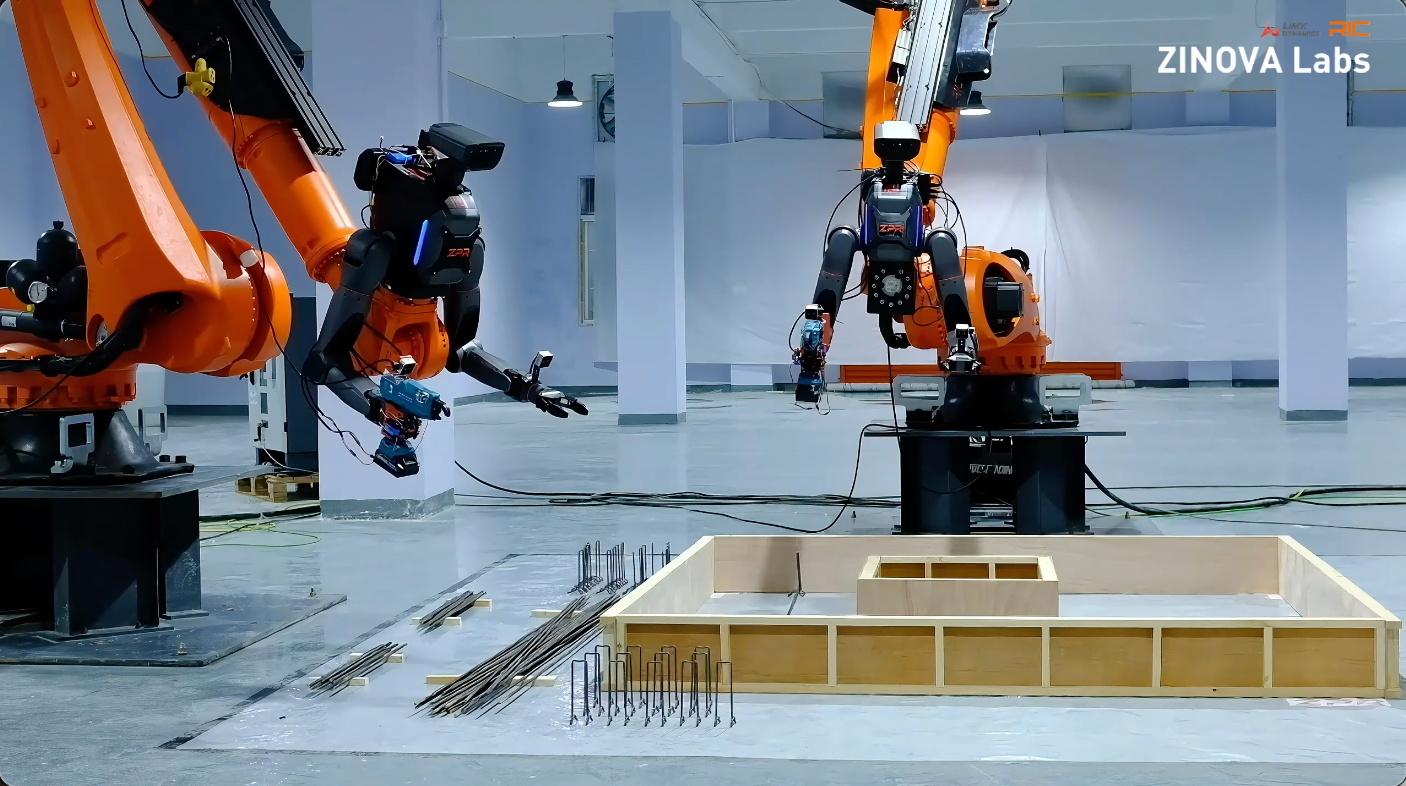
TRON 2 dual-arm robots demonstrate a scaled-down tilt-up construction workflow
ZINOVA Explores Tool Intelligence: Teaching Robots to Use Tools
ZINOVA focuses on Tool Intelligence, enabling robots to recognize, grasp, sense, and operate existing real-world tools to perform productive physical work.
Its research spans three areas: Grasp, for general-purpose tool grasping; Feel, using the Tool–Embodiment Interaction Sensing Interface (TEISI) to capture force, torque, vibration, and resistance; and Form, exploring robotic embodiments designed for specific tasks. Together, they form a Tool Intelligence framework that can transfer across tools, tasks, and robotic forms.
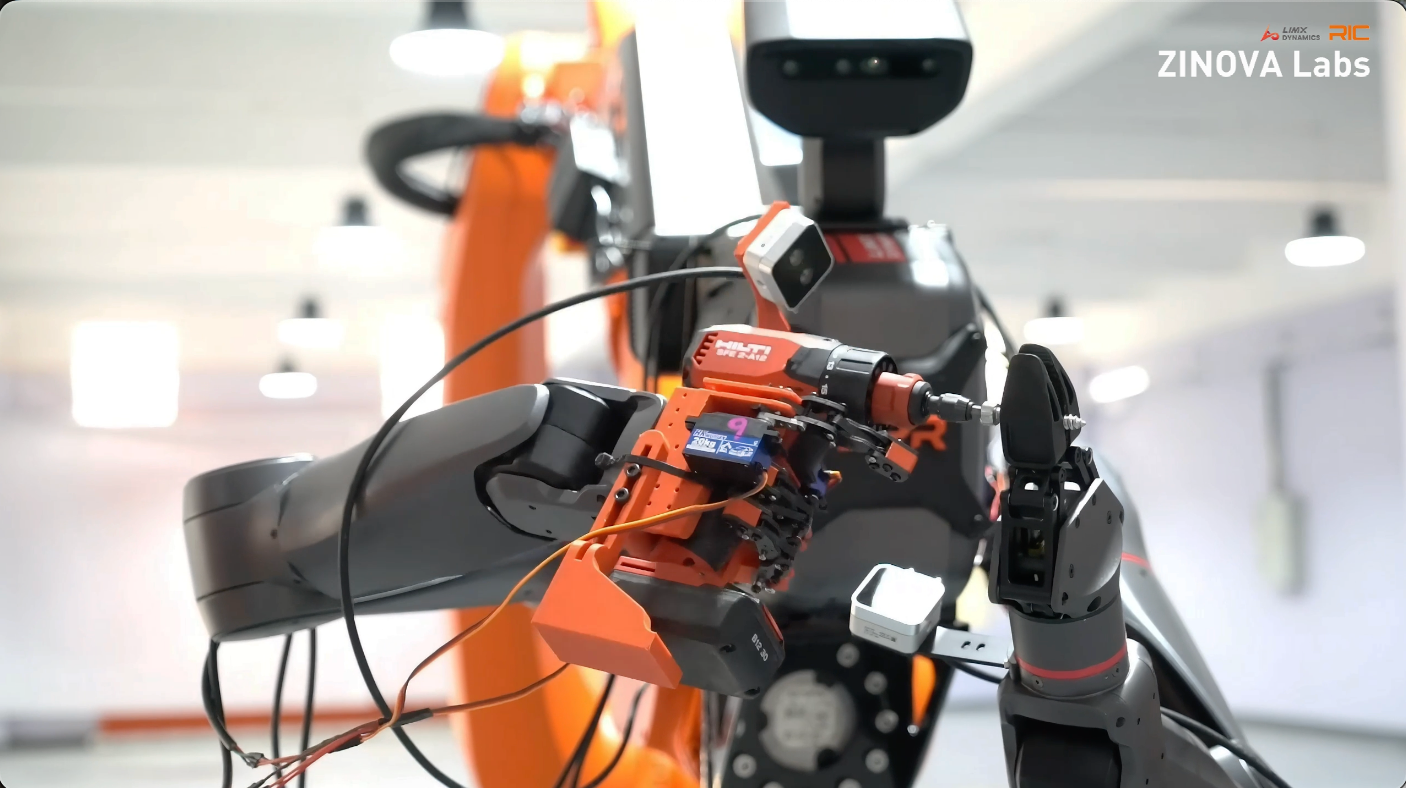
TRON 2 performs coordinated dual-hand manipulation with precise tool grasping
Construction: Tool Intelligence’s First Real-World Testbed
Construction is ZINOVA’s first industry for real-world validation. The sector faces skilled labor constraints while relying on a wide range of high-value physical tasks and established tools.
Construction sites are also highly non-standardized. Environments, materials, and processes vary from project to project, making standardized automation difficult to deploy. This complexity makes construction an ideal testbed for the real-world adaptability of Tool Intelligence.
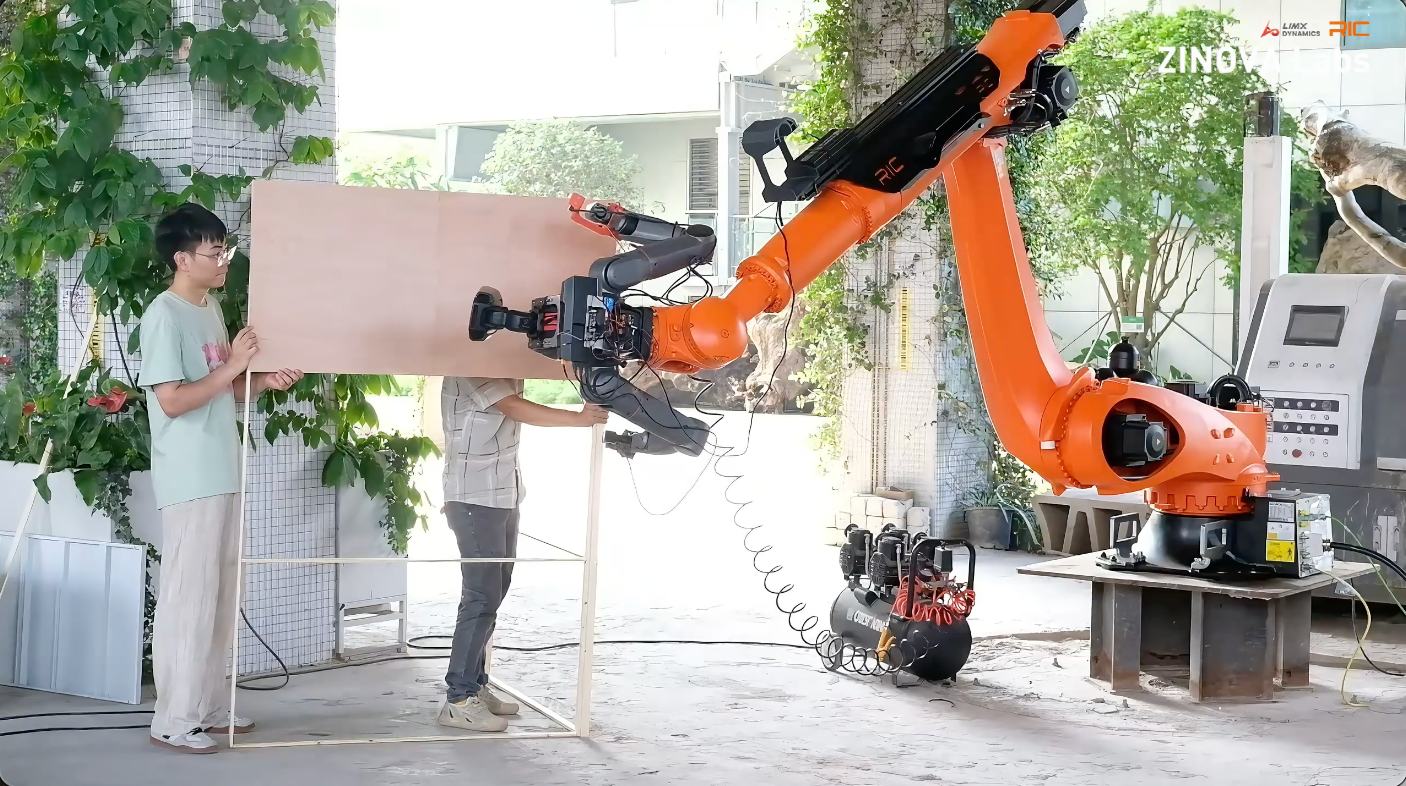
The demonstration recreated key stages of tilt-up concrete construction. Two TRON 2 robots worked together to assemble and secure formwork, with one operating a nail gun and the other handling wooden boards. They then placed and tied rebar across multi-layer supports, simulating a workflow that traditionally requires multiple trades. The challenge was not a single robotic skill, but connecting multiple tasks into a complete physical workflow.

Two TRON 2 work together to assemble and secure the concrete formwork
Building on TRON 2’s modular and extensible design, ZINOVA also explored a new robotic configuration tailored to the large workspaces and multi-step tasks of construction. The configuration further expands TRON 2’s workspace and tool manipulation capabilities, enabling its dual arms to operate tools across different orientations and heights and unlocking greater potential for complex construction tasks.
TRON 2’s dual arms operate multiple tools across different orientations and heights
Three Insights Behind the New Configuration
- Generalization across tasks. Construction involves many processes and tools. Building a dedicated robot for each task would increase both cost and deployment complexity. TRON 2’s modular design supports different tools and base configurations, allowing the same platform to extend across more construction workflows without building a new robot for every task.
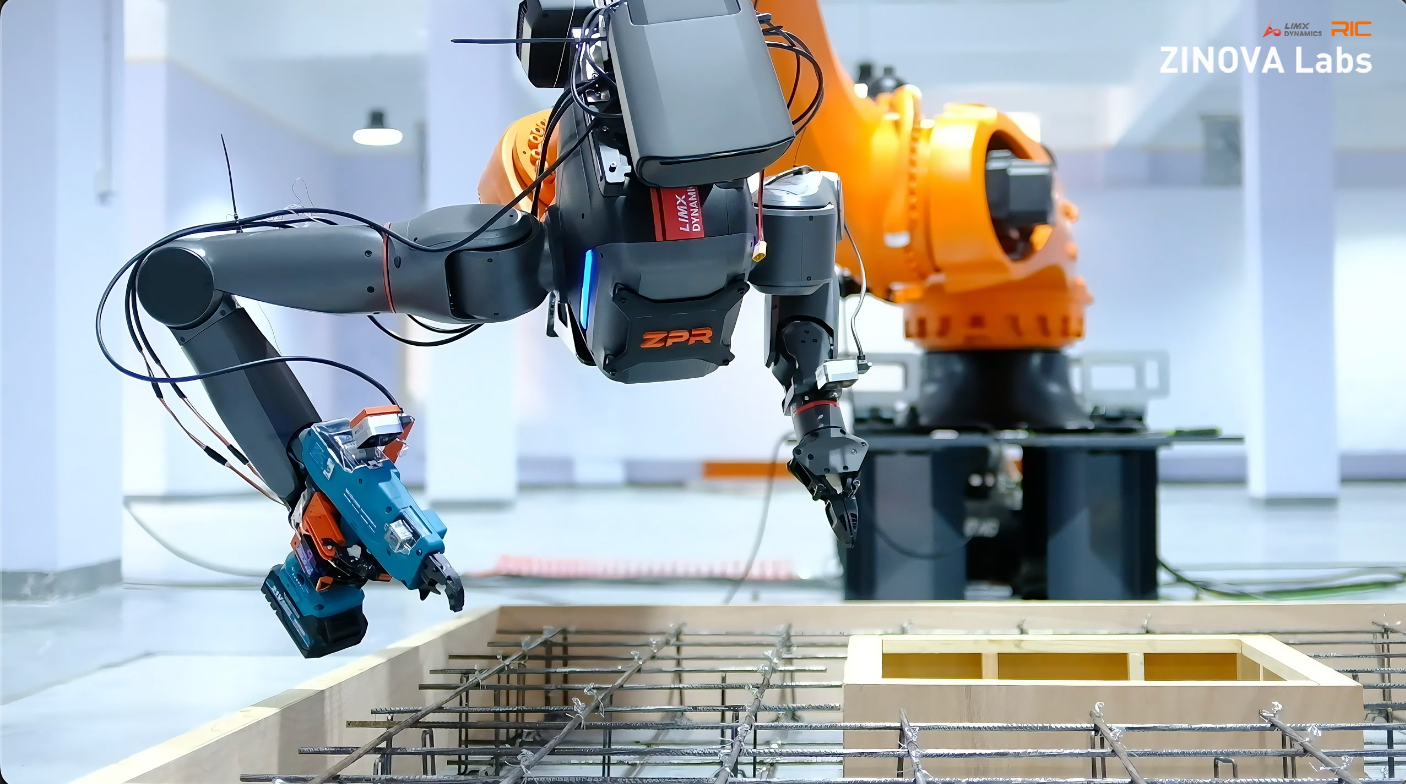
TRON 2 operates a nail gun to perform fastening tasks
- Human in the Loop. Construction sites are highly non-standardized, making full autonomy challenging today. TRON 2 supports teleoperation, allowing operators to step in at critical moments to handle unexpected conditions and ensure task completion and quality. These real-world operations also generate valuable data on robot motion, tool use, contact, and environmental interaction, providing a foundation for future model training.
- Compliance and efficiency. Construction tasks often involve different professional qualifications, licenses, and subcontracting arrangements. Carpenters, ironworkers, and concrete workers may operate under different requirements, adding organizational complexity. A unified robotic platform could perform tasks across traditional trade boundaries while meeting applicable safety requirements. This could reduce workflow friction and support future deployment at scale.
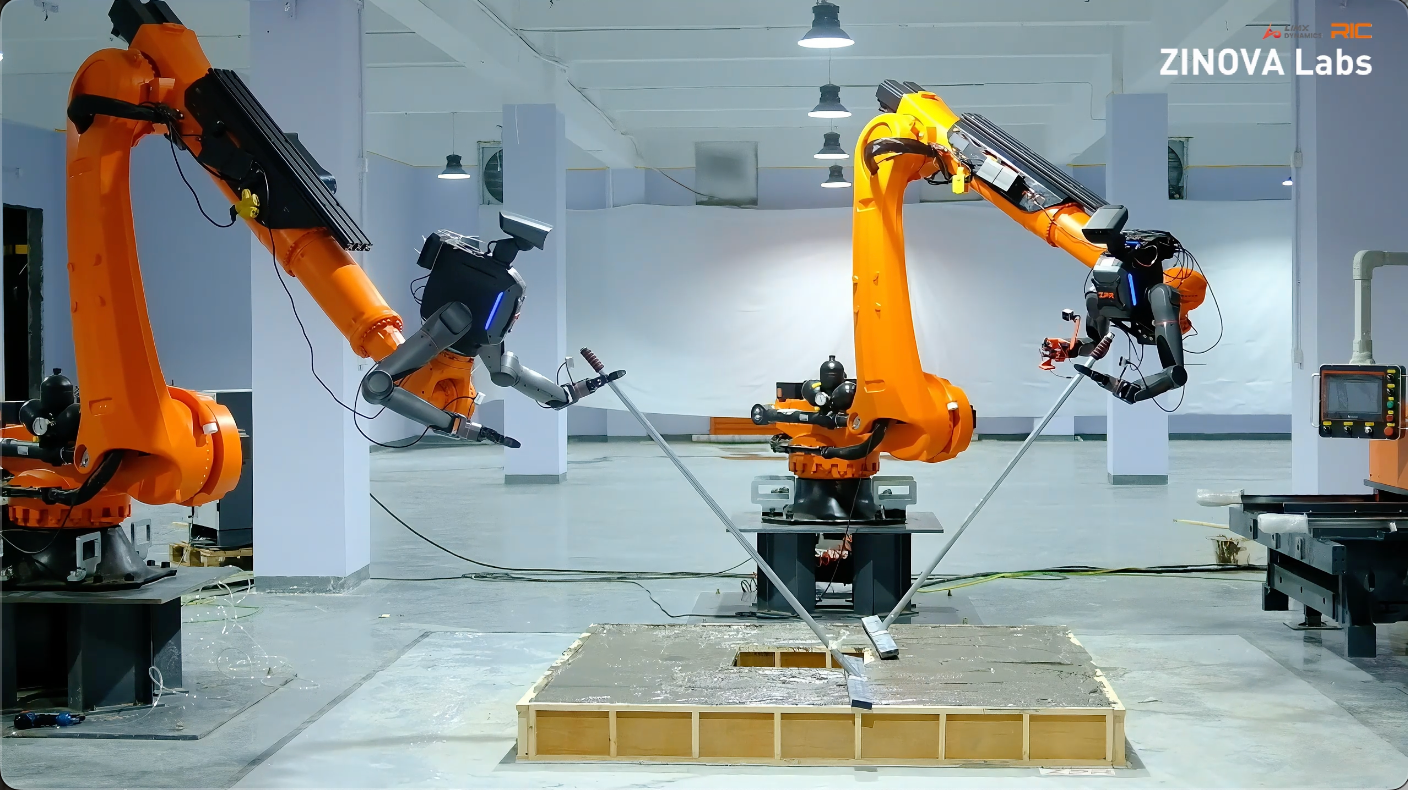
Two TRON 2 work together to smooth the concrete surface
One Robot, Multiple Workflows: TRON 2 as an Innovative Embodied Robotic Platform
ZINOVA’s work in construction demonstrates LimX Dynamics’ platform-oriented strategy. LimX Dynamics provides industry customers with three foundational capabilities: robot hardware platforms, developer toolkit platforms, and open-source model training infrastructure.
Through open SDKs, teleoperation interfaces, hardware adapters, and other supporting tools, LimX Dynamics enables industry innovators to build applications on mature robotic platforms. This allows them to focus on domain-specific challenges rather than developing foundational robot hardware and software from scratch. TRON 2 embodies this strategy as a reusable and extensible innovation platform for embodied intelligence.
Ziyou Xu, Founder of ZINOVA, said: “We believe the breakthrough in physical AI will not come from a single robotic form, but from intelligence that can use tools across different embodiments. TRON 2’s modular and extensible design allows us to focus more on Tool Intelligence and real industry tasks, while quickly validating different robotic configurations and applications.”
Bruce Pang, Co-founder of LimX Dynamics, said: “ZINOVA’s deep understanding of construction and its focus and innovation in Tool Intelligence are exactly the kind of ecosystem expertise needed to bring embodied intelligence into real-world applications. With an innovative embodied robotic platform like TRON 2, we want to empower industry innovators to validate and iterate faster, and together explore more solutions for real-world needs.”
Starting with construction, ZINOVA plans to expand Tool Intelligence into manufacturing, energy, infrastructure, and other industries that depend on complex physical work. LimX Dynamics will continue to advance its general-purpose robotic platforms and work with more industry innovators to build an ecosystem for physical AI applications, accelerating the transition from technical validation to broader real-world deployment.