FluxVLA EngineA Standardized Engineering Foundation for VLA
Bringing VLA from Simulation to Real Robots
Unified Configuration

Real-Robot Ready

Model Compatibility

Modular by Design

Hardware Extensibility

Accelerated Inference
Unified Configuration, Centralized Management.Unified Configuration, Centralized Management.
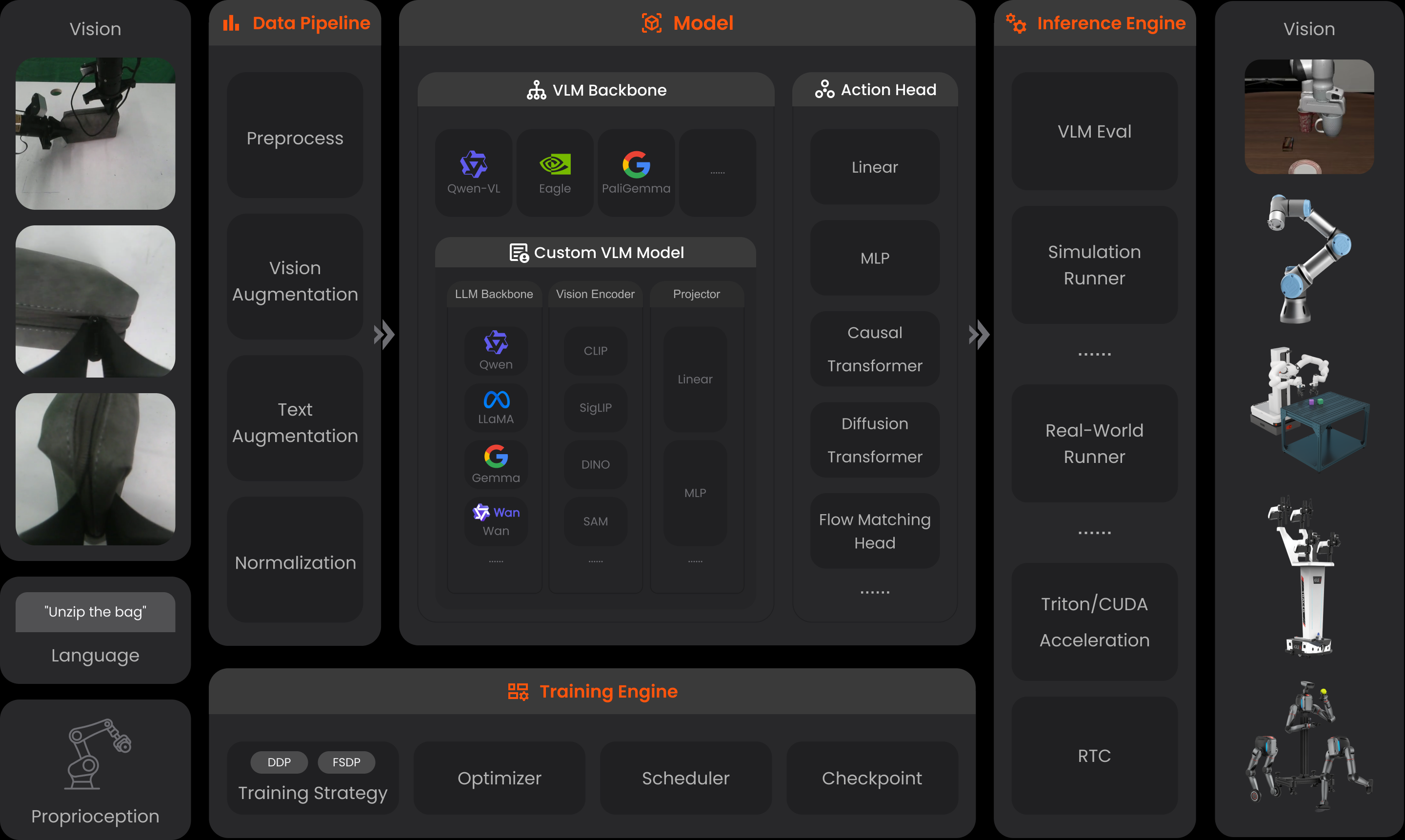
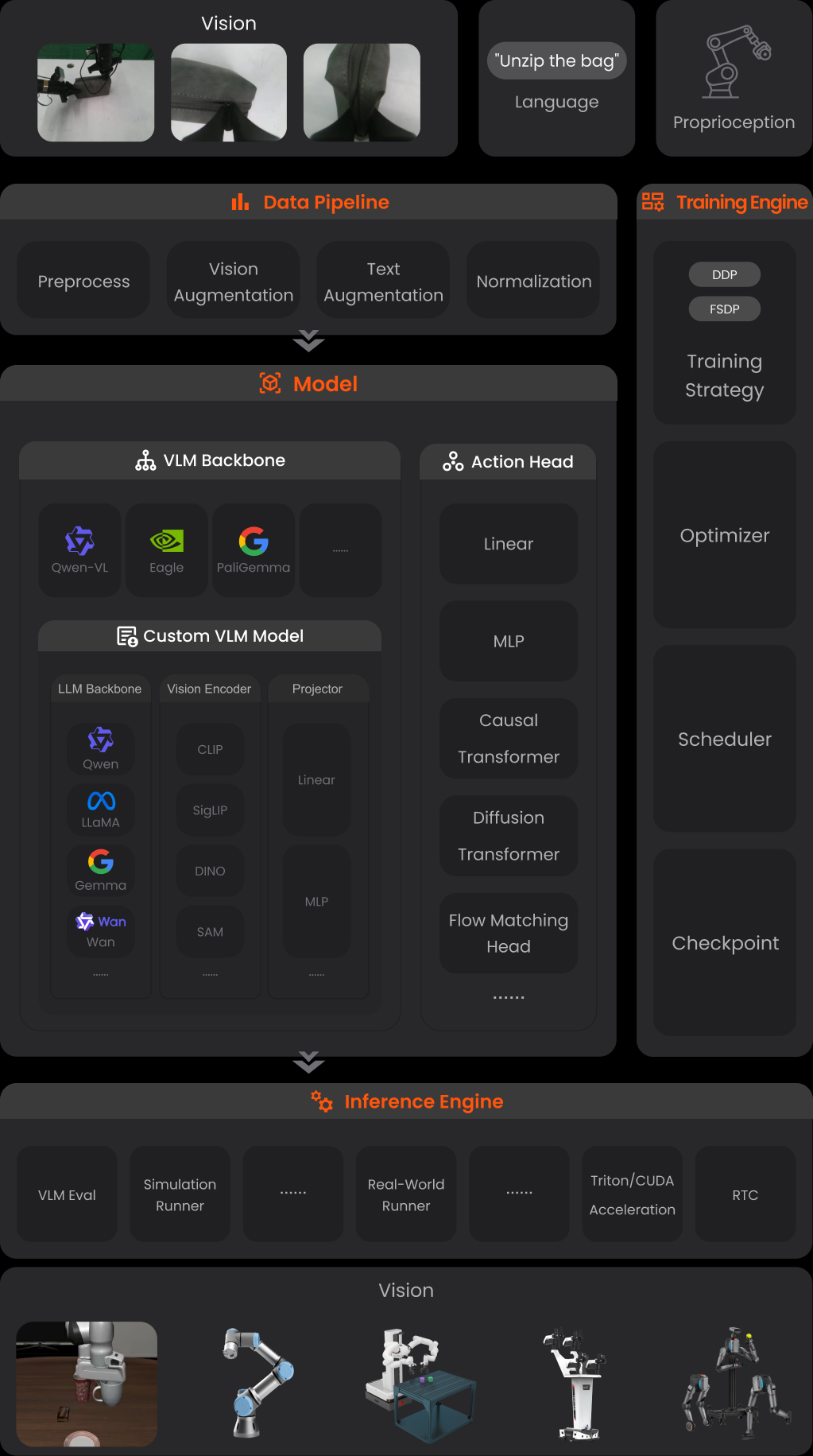
From data pipelines and model selection to training, inference, simulation, and real-robot deployment, FluxVLA Engine uses a unified configuration system. With a single configuration file, users can centrally manage data processing, model components, training strategies, evaluation, inference, and deployment parameters, and switch between setups with one click—so teams can stay focused on core development and experimentation.
Decoupled Modules, Fast Composition.Decoupled Modules, Fast Composition.
FluxVLA Engine adopts a purpose-built modular architecture with standardized interfaces across the entire workflow. Components such as vision encoders, language backbones, and action heads can be replaced independently. New datasets and tasks can be integrated without framework-level changes, making it faster to build custom VLA models.
Ready Out of the Box, Efficient Validation.Ready Out of the Box, Efficient Validation.
Once training is complete, models can be deployed to real-robot platforms through a standardized workflow. This bridges the sim-to-real gap and accelerates the loop from algorithm validation to physical execution. A full end-to-end workflow can be completed in as little as 30 minutes.
Standardized
Deployment Workflow

30 Minutes
End-to-End Workflow

Full-Stack Training, Building More Intelligent Robots.Full-Stack Training, Building More Intelligent Robots.
FluxVLA Engine natively supports both Vision-Language Models (VLMs) and Vision-Language-Action Models (VLAs), unifying perception, language understanding, and action training within a single framework—enabling robots to act as semantic agents in open environments.
Easy to Connect, Easier to Build.Easy to Connect, Easier to Build.
At the model layer, FluxVLA Engine supports VLM, VLA, and WAM models—including Qwen, GR00T, and the Pi series—through unified interfaces, simplifying model integration. At the simulation layer, it supports mainstream simulators such as Isaac Sim, LIBERO, and RoboCasa, helping reduce environment setup complexity and streamline the development workflow.






Diverse Hardware, Broadly Compatible.Diverse Hardware, Broadly Compatible.
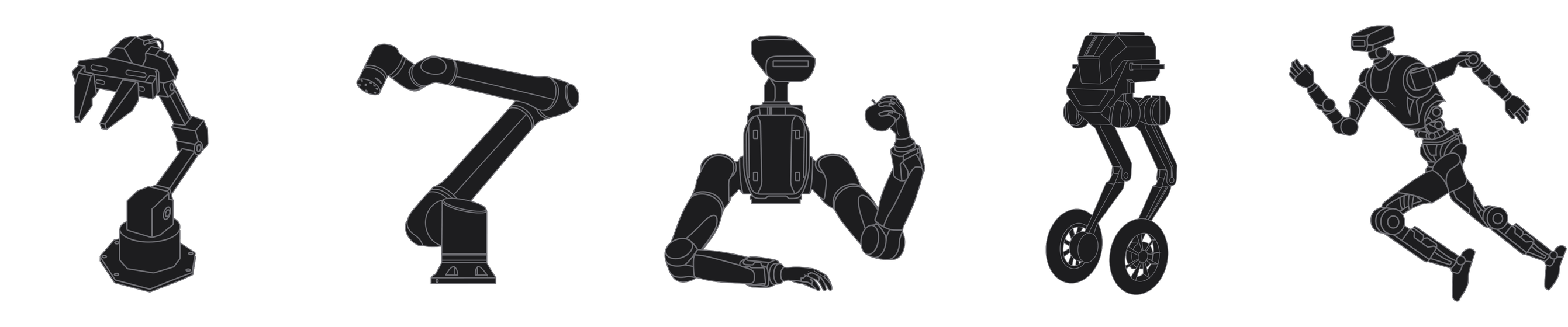
FluxVLA Engine supports a wide range of mainstream hardware platforms, including LimX Dynamics Oli, TRON 2, UR collaborative robots, and ALOHA dual-arm systems, with more platforms continuously being added.
Industry-First
Full-Category Device Integration

Fast
Hardware Platform Switching

Accelerated Inference, Exceptional Performance.Accelerated Inference, Exceptional Performance.
Through inference engine optimization and operator fusion, FluxVLA Engine delivers a 5–10x inference speedup, allowing robots to respond faster to environmental changes with smoother real-time control. It also integrates Real-Time Chunking (RTC) and other advanced trajectory smoothing methods to ensure stable and fluid robotic execution.
5–10x
Inference Speedup

RTC
Trajectory Smoothing

Open Collaboration, Continuous Evolution.Open Collaboration, Continuous Evolution.
Built on years of engineering experience at LimX Dynamics and backed by long-term enterprise-grade iteration, FluxVLA Engine is open source across code, model weights, and documentation. Developers are free to use, modify, and contribute to the project. Looking ahead, FluxVLA Engine will further explore integration with Reinforcement Learning (RL) and World Models, while building an open-source community with the ecosystem to accelerate embodied intelligence toward real-world applications.

Developer Community
Accelerate Embodied Intelligence, Together
FluxVLA Engine is now available on Alibaba Cloud PAI for developers to use. Visit the GitHub repository for the latest updates and technical support.
* Please use this product in compliance with applicable laws and regulations.
** Page data was measured in LimX Dynamics laboratories. Actual performance may vary depending on environment, usage, and software version. Please refer to actual results.
*** All product descriptions, images, and screen content are for reference only. Actual product performance and appearance may vary.
